
The Worn Out Archaeologist
My (literal) archaeological backstory and the worst summer of my life

I sat on the floor of the living room digging through my old steamer trunk, my knees protesting against the hardwood, my elbows deep in the memorabilia of what has felt like a lifetime, yet in reality only represents the beginnings of one.
I have often wondered what this trunk, covered in old visa stamps and names of people I have never met and places I may never go, might have once held as it followed its people from place to place. But right now, I know exactly what’s in there - a big stack of old books, binders ranging from elementary school to community college, my two old flutes (one in perfect condition, one bent in half from the time I sat on it in middle school), and a pile of clothes.
Every now and then I like to pull out my figurative trowel and go excavating for the memories I store in boxes and trunks, searching for pieces of myself I have left behind. In each excursion, I dig like an archaeologist for fragments of past selves I have worn and worn out. The dust, like the dirt of a field site, settles on my body - and especially under my fingernails - as I pull out old journals, reading my teenage words like a linguist attempting to decipher ancient glyphs, and attempt to recreate sounds on my flute I once knew how to play like an experimental archaeologist reviving music that has been lost to time.
Amidst the layers of detritus made up of paper, metal and wood, my hands brush against pieces of fabric. The little archaeologist in my head perks up, alerting me to a change in the makeup of this material evidence that could hold the key to unlocking the secret of a life long forgotten. Pushing past the layers, I find a gray t-shirt, a purple button down, and, in an exercise of auto-archaeology (if such a thing exists), I remember what’s missing from the group. A pair of hiking boots that take up residence in my hall closet and my tan hiking pants that are, hopefully, still being enjoyed by a friend. Were the ensemble complete, it would encapsulate the archaeologists’ uniform that I embodied in the summer of 2021, working with the Great Basin Institute and the US Forest Service on an archaeological survey in middle-of-nowhere Susanville, California.
The Shirt
Summers in California are hot - not the sweltering humid heat of the South, but a dry heat that cracks your lips and threatens to spark raging wildfires with each suggestion of a breeze. Susanville in summer was, somehow, even hotter than the rest of the state. It’s nestled neatly in between the convergence of two mountain ranges and right next to the high desert of North America - both of which caught on fire that summer and choked the town in layers of smoke and ash. The town itself is small and devoid of much of anything - a singular main street that cuts through the city marking the only way in or out, lined with defunct local restaurants, the occasional gas station, and… not much else. It was small, almost alien to my urban eye, and the surrounding environment looked as if it could have stepped out of a movie featuring space exploration to desolate exoplanets.
It is also the place I had run to with excitement and that bright-eyed look of any young professional with their first opportunity to grow into a career they had been dreaming of for years. In this tiny high desert town, I was taking up the responsibilities of my first archaeological field season - a real, bona fide job - paid and everything! The work was going to be grueling, but all I had on my mind was the rush of elation I felt that first day of training as my crew mates and I literally jumped into the Ford F-250 that towered over our heads. We drove to the Forest Service field station where we met with the district archaeologist and the Great Basin Institute trainer for orientation starting with out gear, and what I was most excited for - the gray, Great Basin Institute branded t-shirts that represented the beginning of the rest of my life. I felt such a sense of pride as I inspected the logo above the left breast - the outline of a brown mountain with “Great Basin” underneath, and “Institute” following that, alongside the circular “AmeriCorps” logo on the right shoulder.
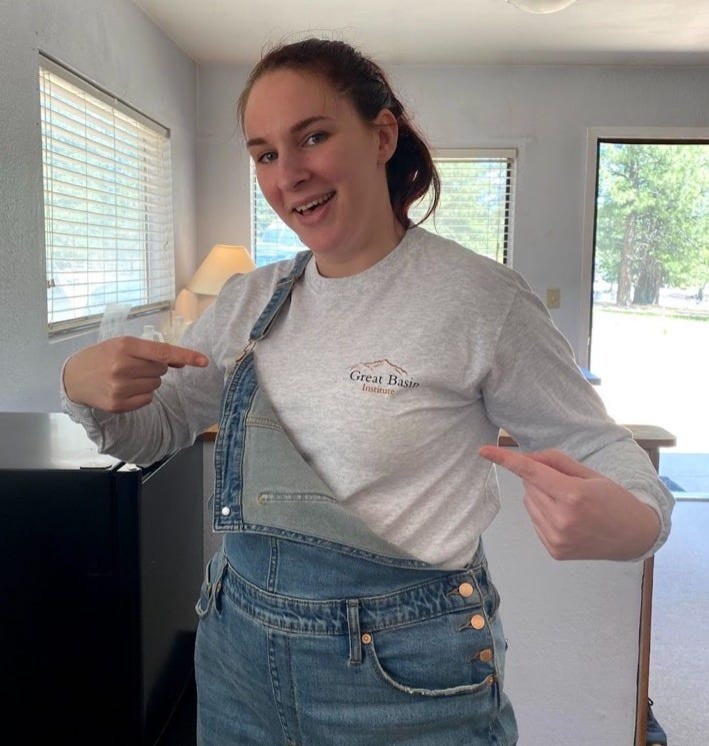
Receiving that t-shirt felt like a confirmation that I was finally doing it. I was becoming the person I had wanted to be since taking my first archaeology class in community college. I had dreamed of what life as an archaeologist would look like for myself, thinking up adventures to faraway places; roughing it in the rainforests of Central America as a Mesoamerican archaeologist or traversing oceans to make my way as a classicist in ancient Rome or Greece. In my imagination, it felt like the balmy nights in Belize, praying that the rainy season would come to relieve us of the oppressive heat, of linen button-down shirts drenched in sweat. It felt like tank tops pressed against dirty skin as I leaned over an excavation unit to take in the scene of a groundbreaking archaeological site. It felt like the comfortable practicality of utilitarian clothing that, in a way, still represented a sense of style that has been captured in, and romanticized through, photographs of colonist archaeologists and explorers.
Instead, I stood in a foreign, quiet, and empty town, and had my somehow already dirty hands clutched around the gray flecked cotton blend so familiar to the touch that it could have been any t-shirt I had blindly pulled out of my dresser. It simply didn’t feel the way I had hoped it would… but I shrugged it off, chalking the minor disappointment up to the nerves of training day, choosing to exchange the linen button down I had worn that day for this new shirt to proudly show my status as a seasonal archaeological technician. My crew mates, after all, didn’t think this hard about what they wore and why they wore it - a commonly shared sentiment among most archaeologists. As long as it kept them clothed, protected from the elements, and was easy to move in, their requirements for fashionability had been met.
I decided to try and be more like them, leaving behind the romantic expectations I had held onto for so many years in favor of accepting this disappointing t-shirt to show the excitement and accomplishment I felt for having landed a paid archaeology gig. I was going to put my all into this t-shirt, wearing it as many days as I reasonably could before it needed to be washed, ensuring that it was marked with the memories of my first real job as an archaeologist. It didn’t take long for that slightly disappointing t-shirt to become less gray and more of a dirt-stained brown - an uncannily accurate representation of the shitty field season I was about to have.
The Shoes
I had never spent so much money on a pair of shoes before. But, wanting to ensure my physical safety and well-being, I had stopped at the local shoe store in Susanville to be “properly” fitted for a new pair of boots that would sustain me through the season. Three hundred dollars later and my boot stipend entirely spent, I walked out with the most comfortable pair of boots I had ever put on my feet. They were visually underwhelming, sporting a thoroughly unexciting brown and black color palette, but I could feel every step that I took and every rock and twig underfoot, providing just the right amount of sensory input to keep me safe without leaving me footsore at the end of the day.
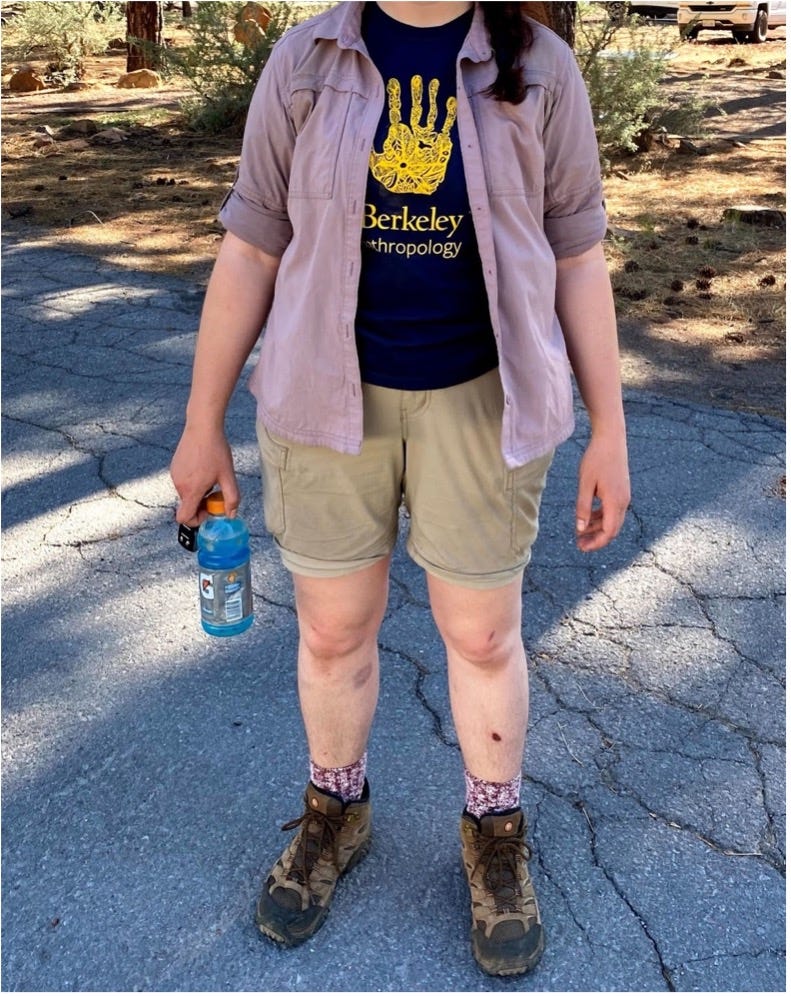
By the middle of the field season, my brand new hiking boots had suffered the wear and tear you might associate with years of enthusiastic hiking, but the rough terrain and ten hour days full of walking from one end of a transect to the other were not entirely to blame. We had hit month three of four that made up the field season and given the rampant wildfires that we were working through, it was about time to properly take care of my gear and at least attempt to rid it of the ash and smoke that blanketed every surface. On a rare clear evening, I had left my boots on the front porch to air out overnight where they were promptly attacked by the next door neighbor’s new puppies like my boots were the backyard chickens they were always after. I begrudgingly admit that the puppies were adorable, but my fondness towards them was abruptly ended when I found my boots torn up beyond wearability the next morning. Shoelaces were missing, heels had been swallowed, and a thick layer of dried slobber coated my hands as I inspected the damage.
Finding my poor boots - the shoes that quite literally got me through my days - ravaged by a pack of dogs felt like the final bead on a string of unfortunate events that had made up the field season thus far.
First, there was the sexual harassment myself and my fellow female crew mates had endured from our crew lead.
Then came the power outages caused by the critical equipment failure at the power plant, leaving us without air conditioning in 105+ degree weather and no running water - all of which was exacerbated even further by wildfire after wildfire that the government insisted we worked through despite dangerous air quality index numbers.
While the worst summer I’d had in recent memory flashed through my mind, I briefly entertained the idea of asking my neighbors to compensate me for the cost of a new pair of boots - but the Trump 2024 flags, “Fuck Biden” bumper stickers on beat up cars alongside the carefully spaced “we don’t call 911” signs on every post of their wire fence had me deciding that $300 was a fair price to pay to avoid a potential conflict. I was scared, exhausted, and quite frankly, the mounting disappointment in what was supposed to be an exhilarating first step as an archaeologist had me on the precipice of quitting early so I could go home where I could breathe without coughing.
I started to feel my archaeological future unraveling under the stress, and truthfully, the only thing that kept me from quitting that morning was the promise of the AmeriCorps education award waiting for me at the end of my contract. A girl’s gotta pay her tuition after all. Defeated, I headed inside to dig out my old horseback riding boots I had brought as an emergency backup from the corner of the closet. I reluctantly tied them on, knowing how sore my feet and ankles were about to be for the next few weeks, and pulled the hems of my tan hiking pants down over them.
The Pants
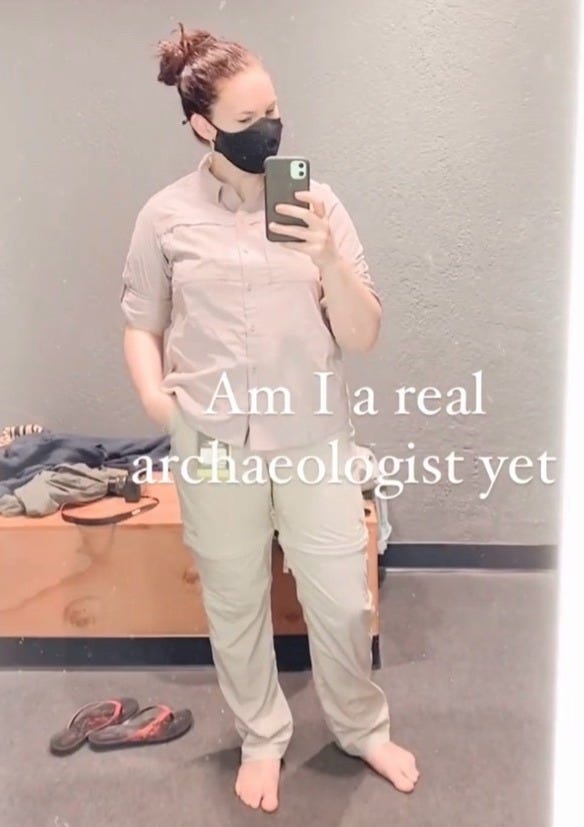
Those pants were the first item I bought for this trip. They promised comfort in the adjustable waist and the legs that converted into shorts through zippers just below the knee. In my previous volunteer stints, I had simply worn jeans. Knowing I wouldn’t survive four months wearing jeans in the extreme heat of the high desert, I remember standing in the REI dressing room shortly before my trip, cargo pants on and snapping photos to post on my Instagram stories, asking my friends and followers if I looked like a “real” archaeologist yet. I wore those tan pants at least half of the time I was in Susanville - but now they’re gone, conspicuously missing from my steamer trunk collection. While I kept the shirt and the chewed-up boots (which I actually still wear because I can’t afford to replace them), the tan pants have gone to a friend I thought would value them more than I would, effectively cutting me off from the possibility of doing archaeology again unless I spent precious money I don’t have on a new pair of pants.
My archaeology-doing pants are gone, my boots are still in active rotation after some triage, but I sat on the floor of my living room still holding that gray-flecked, GBI branded t-shirt. Poised over the open lid of my steamer trunk, I pondered the meaning of this shirt, like any good archaeologist, wondering what it meant to the person that used it. I can tell you now that it once represented all of the excitement of new opportunities and an imagined future of archaeological possibilities, but now its marred with the bad memories of sexual harassment and the literal stains of wildfire smoke, the smell of which somehow still clings to the cotton blend fibers of the jersey fabric.
And yet, I can’t let it go - it sits in the old steamer trunk where all manner of memorabilia sits in limbo, waiting for the next time I excavate them layer by layer to reminisce and reinterpret.
I’ve held onto this artifact of myself just as I have held onto my archaeological, and by extension, anthropological teachings and practices. It reminds me of my community college class, telling my professor I wanted to do cultural anthropology, “but like, with dead people”, and learning there was a word for that - archaeology. It reminds me of how, despite a constantly shifting identity and despite the bad memories, I can’t deny how formative of an experience archaeology has been in my life. It reminds me that because of the turmoil of summer 2021, I emerged with a clearer path forward as I stepped away from archaeology and closer to studying fashion.
I laid the shirt back to rest in its stratum, returning it to its context, and backfilled my exploratory unit with thirty-something years of my life marked in paper and objects, wondering what a future archaeologist might interpret from this garment. But above all I’m reminded by the lingering smell of what one might mistakenly assume is the nostalgic aroma of nights around a campfire why I’m not an archaeologist anymore.
I loved going down this memory lane with you. Your writing makes me feel like I’m there, sitting next to you while you talk through the objects of the trunk and your memories flooding through.
I for one am so happy that this tough summer led you down a different path, because if it hasn’t, we might not have met and become friends and I’m grateful everyday for that!
Really enjoyed this perspective and the concept of ‘auto-archaeology’. It reminded me also of my own transition from fashion industry to software engineering. It’s fascinating to see how people discover they should shift direction, and what concepts they take from the old field into the new one.
Random aside: now I’m wondering if dyed red hair is a right of passage 😂